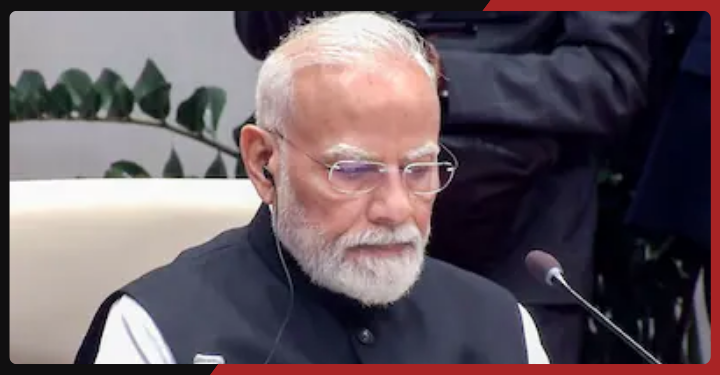
Prime Minister Narendra Modi’s address at the Shanghai Cooperation Organisation Summit brought the issue of terrorism firmly back to the centre of international debate as he called for a united and consistent global response.
Speaking before leaders from across the region, PM Modi made it clear that terrorism must be confronted without double standards.
The significance of his statement increased because Pakistan Prime Minister Shehbaz Sharif was present at the summit.
PM Modi called on SCO members to take collective action against the entire ecosystem supporting terrorism, including its funding, recruitment, radicalisation and safe havens.
India has consistently used international platforms to raise the issue of terrorism.
For New Delhi, the challenge is not limited by geography.
Terrorist networks can operate across borders and use global systems for communication and finance.
This makes international cooperation essential.
The Prime Minister’s emphasis on ending double standards reflected India’s concern that selective approaches can weaken the global fight against terrorism.
If countries take strong action against some extremist groups while ignoring others, the overall security threat can continue to grow.
PM Modi’s appeal was therefore for a common international position.
Every form of terrorism must be condemned and confronted.
The Prime Minister’s call for action against terror financing highlighted one of the most important areas of modern counterterrorism.
Money enables organisations to maintain their operations.
It can support recruitment, propaganda and logistical networks.
International cooperation is needed to identify and block these financial channels.
Recruitment and radicalisation are equally important challenges.
Extremist organisations often attempt to influence vulnerable individuals through ideological propaganda.
Digital platforms have increased the speed with which such messages can spread.
Preventing radicalisation therefore requires modern strategies and closer cooperation between countries.
Safe havens represent another serious concern.
Terror groups become more difficult to defeat when they have secure spaces or networks from which they can operate.
PM Modi’s call for dismantling the complete ecosystem showed that India supports a broad and coordinated approach.
The presence of Shehbaz Sharif made the SCO address particularly important for observers of South Asian politics.
India and Pakistan have long experienced tensions over terrorism and security issues.
PM Modi’s remarks ensured that India’s position was presented clearly before a major international audience.
The SCO itself provides an important platform for such discussions.
The organisation brings together countries facing different challenges but sharing an interest in regional stability.
PM Modi’s speech suggested that cooperation against terrorism should be one of the strongest areas of common action.
The Prime Minister also connected security with the future of regional development.
Trade, investment and connectivity can grow only when countries have a stable environment.
Terrorism threatens that stability.
For this reason, counterterrorism is closely linked to economic prosperity.
PM Modi’s message at the summit was both a warning and a call for cooperation.
The warning was against allowing political interests to create double standards.
The call was for governments to work together against every part of the terror ecosystem.
His remarks demonstrated that India will continue to treat terrorism as one of its most important international priorities.
With major regional leaders listening, PM Modi used the SCO platform to reinforce a clear position: terrorism is a challenge to humanity, and the international community must respond with unity, consistency and determination.
There can be no selective response to a threat that crosses borders.
The world, according to India’s message, must stand together and act decisively to protect peace, security and the future of regional development.